
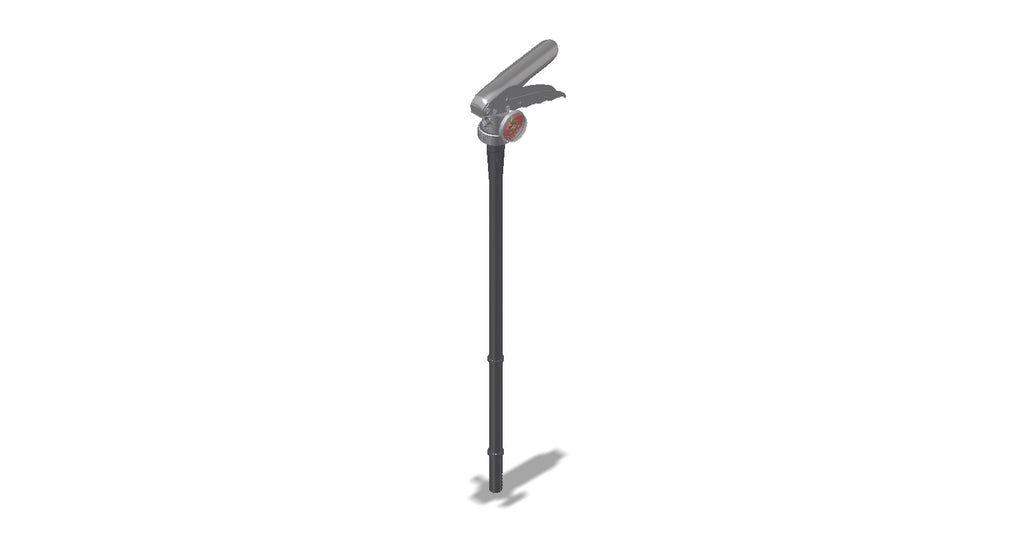
Search "lithium battery fire extinguisher" and within a click or two you are looking at a 30 lb Amerex Class D unit. It is a real product, genuinely built for lithium — and for the thing most people are worried about, a swollen laptop pack or an e-bike battery, Amerex's own catalog tells you not to use it. Of the C571 copper unit it writes: "Not recommended for lithium-ion battery fires." That is the manufacturer declining to sell you what you came for, and understanding why sorts out two very different buyers.
Lithium metal and lithium-ion are not the same hazard
Amerex's class table defines Class D as "Combustible metals or combustible metal alloys," with the examples "Magnesium, titanium, zirconium, sodium, lithium, and potassium." Those are metals and metal alloys in physical form — ingots, chips, powder, swarf, spills, molten baths — not assembled cells.
The C571's agent was built for one of them. The catalog says it "contains a copper extinguishing agent specially developed by the U.S. Navy for fighting lithium and lithium alloy fires," and that "Copper powder has been found to be superior to all other known fire extinguishing agents for lithium metal fires." The service manual for the copper unit calls it "a specially formulated copper powder developed by and for the U. S. Navy specifically for combating LITHIUM and LITHIUM ALLOY fires," then narrows the approval: "USE THIS EXTINGUISHER ONLY ON CLASS D BURNING METALS. (At the date of this printing, the Model 571/B571/C571 has been laboratory tested and approved for molten LITHIUM fires only.)"
A lithium-ion cell is not molten lithium metal. Amerex draws that line itself and then stops. Across the Amerex library we work from — the current portable catalog, the Parts Book and the owner's service manuals — the phrase "lithium-ion" appears exactly once, as an exclusion. No Amerex publication we hold lists any extinguisher, in any agent, as approved for lithium-ion battery packs. Any page claiming otherwise about an Amerex unit is not quoting Amerex.
Class D ratings don't look like 4A:80B:C
If you read UL ratings off a nameplate, Class D will throw you. The catalog's Class D specification table has no UL rating row at all. Amerex publishes tested capacity instead as an area and a quantity of metal. The first six rows below are the B570's published capacity table; the last is the separate figure published for the C571.
| Hazard | Approximate area — ft² (m²) | Quantity of metal — lbs (kg) |
|---|---|---|
| Magnesium chips | 4 (.37) | 6 (2.72) |
| Sodium spill | 5 (.46) | 5 (2.26) |
| Sodium spill — depth over ½ inch (1.3 cm) | 3 (.27) | 6 (2.72) |
| Potassium spill | 5 (.46) | 5 (2.26) |
| Potassium spill — depth over ½ inch (1.3 cm) | 3 (.27) | 6 (2.72) |
| Sodium potassium alloy spill | 3 (.27) | 2 (.9) |
| C571 copper — lithium metal | "4 ft.2 and/or approximately 5 lbs. of lithium metal" | |
The C571 row is quoted whole because Amerex publishes it as a single "and/or" statement, not a two-column pair. Amerex states the B570 "contains Sodium Chloride dry powder which has been tested and approved by Factory Mutual Systems (FM) for use on the combustible metals listed in the table," and the catalog lists both 30 lb models as FM Approved and "MANUFACTURED AND TESTED TO UL STANDARDS." Our guide to what fire extinguisher UL ratings actually mean covers the A and B numbers everywhere else in the line.
The two agents, side by side
| B570 — Sodium chloride | C571 — Copper | |
|---|---|---|
| Agent | Blended sodium chloride dry powder (Super D) | Copper powder (Navy 125S) |
| Capacity (lbs) | 30 | 30 discharged* |
| Cylinder diameter (in.) | 8 | 7 |
| Height (in.) | 35 | 34 |
| Range, initial (ft) | 3–6 | 3–6 |
| Discharge time (sec) | 24 | 24 |
| Nominal operating pressure | 195 PSIG | 195 PSIG |
| Valve | Chrome-plated brass, all-metal valve construction | |
| Temperature range | −40°F to 120°F | |
| FM approved | Yes | Yes |
| Included bracket | 803 wall | 877 wall |
*The footnote matters if you buy recharge agent: "Due to the density of copper, extra agent is added to achieve 30 lbs. of agent discharge at a 45º angle. THE ACTUAL EXTINGUISHING RECHARGE AGENT QUANTITY IS 41½ LBS."
Mounting differs too. Amerex's at-a-glance table gives the 8 in. B570 the 803 wall bracket included and the 811 heavy-duty box-type vehicle bracket optional; the 7 in. C571 gets the 877 wall bracket and the 810. The 864 rubber-strap bracket and the 859 dolly cart are listed for both. Both units take the same 10800 "soft flow" extension applicator, which Amerex calls "particularly suited for fighting CLASS D fires. It allows the operator to stand away from the extreme heat and toxic fumes caused by burning material." It detaches at a quick-connect: 3–6 feet of range with the applicator fitted, 8–10 feet from the bare nozzle.
How the agents behave, and what they leave
Sodium chloride works mechanically — "Heat from the fire causes it to cake and form a crust excluding air and dissipating heat from burning metal" — and covers the broader list: "Metal fires involving magnesium, sodium, potassium, and sodium-potassium alloys can be successfully extinguished with this extinguisher. There is data showing that zirconium, uranium, titanium, and powdered aluminum fires can be controlled and extinguished with this unique extinguisher." Copper is the specialist: the copper compound "smothers the fire and provides an excellent heat sink for dissipating heat."
There is a cleanup cost to the sodium chloride unit that buyers rarely price in. The B570 manual puts it in capitals: "SODIUM CHLORIDE BASED POWDER CAN BE VERY CORROSIVE, ESPECIALLY ON METALS. AFTER THE FIRE HAS BEEN EXTINGUISHED AND REMAINS HAVE COOLED, CLEAN ALL SURFACES CONTACTED BY THE DRY POWDER." On machine ways and slides that is a real post-discharge job — the same corrosion argument we make in Purple K vs ABC.
Approvals are per model, and Amerex writes them in capitals
The wheeled manual states most clearly that "Class D" is not one category: "THE MODEL 680 CLASS D FIRE EXTINGUISHER HAS BEEN TESTED AND APPROVED FOR CLASS D FIRES INVOLVING MAGNESIUM, SODIUM, POTASSIUM OR POTASSIUM ALLOYS ONLY. THE MODEL 681 CLASS D FIRE EXTINGUISHER HAS BEEN TESTED AND APPROVED FOR CLASS D FIRES INVOLVING LITHIUM ONLY. DO NOT USE EITHER EXTINGUISHER ON CLASS A, B OR C FIRES." Amerex's Parts Book lists the current versions of those two units as "680R – 150 lb. Sodium Chloride" and "681R – 250 lb. Copper."
Placement is counterintuitive too. The B570 manual says to locate the unit "no less than 50 feet (15 m) from the hazard, leaving unobstructed access"; the copper and wheeled manuals give the same 50-foot minimum. Both portable manuals also warn that "CLASS D FIRES NORMALLY GENERATE EXTREMELY HIGH HEAT."
Argon only, and never mix powders
Both 30 lb models are pressurized to 195 psi with dry argon. The copper unit's manual explains why: "ARGON IS AN INERT GAS THAT WILL NOT ADVERSELY REACT WITH COMBUSTIBLE METALS. NITROGEN PRESSURIZING GAS COULD CAUSE A REACTION WHEN USED ON CERTAIN TYPES OF COMBUSTIBLE METAL FIRES. DRY AIR PRESSURIZATION SHALL NEVER BE USED AS EVEN THE SLIGHTEST AMOUNT OF MOISTURE WILL CAUSE A VIOLENT REACTION WITH CLASS D METALS."
The same reasoning bans water — "NEVER USE WATER ON A COMBUSTIBLE METAL FIRE" — and Amerex's water mist manual says it from the other direction: "DO NOT USE THIS EXTINGUISHER ON CLASS D FIRES OR ANY FLAMMABLES THAT WILL REACT WITH WATER." On cross-contamination, the copper unit's manual is equally blunt: "Mixing ABC, regular, Purple-K, Super-K or Monnex dry chemicals with a dry powder agent could cause a serious flare up or explosion if the dry chemical were to contact a combustible metal fire." Both 30 lb cylinders carry a 12-year hydrostatic interval at 585 psi.
So what belongs near a battery installation?
No Amerex publication we hold offers an agent for the pack itself. What portables legitimately do at a battery event is protect the surroundings — packaging, shelving, cable trays, the bench, energized equipment nearby. Those are ordinary Class A, B and C exposures: a 10 lb B456 is rated 4A:80B:C and covers all three, while CO2 and Halotron BrX are both listed as leaving no residue (see Class C is not a size: CO2 vs Halotron BrX). Amerex is explicit about the trade-off: "Dry chemical is not recommended for fires in delicate electrical equipment or aircraft. Use of this agent may extinguish the fire but may damage the equipment beyond repair." That is the whole honest offer, and it is not "an extinguisher for lithium-ion." Detection and thermal-runaway planning for battery storage are questions for your fire protection engineer, insurer and AHJ.
Welding shop or machine shop? Amerex splits them
If you searched for a welding extinguisher: Amerex's hazard-analysis page assigns welding shops, auto repair shops, manufacturing facilities and high-voltage electrical distribution to carbon dioxide, and machine shops, foundries, metal fabrication shops and heavy industries to Class D dry powder. Slag landing on wood, paper or plastics is Class A by Amerex's own class table; magnesium or titanium swarf in a chip pan is Class D. Shops with both hazards need both extinguishers, not one compromise.
When the portable is too small
If you pour, machine or store combustible metal in quantity, Amerex builds wheeled versions: the 680R at 150 lb of sodium chloride, the 681R at 250 lb of copper. Published approximate discharge times are 80 seconds for the 680 and 120 seconds for the 681, on 25 feet of hose, with 20 to 30 feet of agent throw from the nozzle and 4 to 6 feet with the wand applicator.
These are argon units: a 110 cu. ft. argon cylinder pressurized to 2015 psi, a Victor regulator with a 120 ± 10 PSI static dead set, an agent cylinder hydrostatically tested every 12 years at 500 psi, and an argon cylinder retested every 5 years in accordance with D.O.T. regulations. Our guide to Amerex wheeled unit parts by drive system explains why the expellant gas decides which parts fit.
What we stock
Portables — the C571 copper unit and the B570 sodium chloride unit, the two hand portables in Class D.
Wheeled — the 680R and 681R from our wheeled Class D and specialty range, plus the 10904 charged argon cylinder and the wheeled unit parts shelf.
Agent — 545 Super D sodium chloride, which the Parts Book assigns to the B570 and 680, and 548 copper, assigned to the B571, C571 and 681. Do not substitute.
Parts and mounting — the 10800 soft flow extension applicator, the 803 and 877 wall brackets, and the 859 dolly cart, listed as an option for both cylinder sizes.
For the exposures around the hazard — ABC dry chemical and CO2.
Have a genuine combustible-metal hazard? Send us the metal, the form it's in and the area to cover, and we'll come back with options and lead time — request a quote.
Sources
Agent descriptions, capacities, dimensions, cylinder diameters, discharge data, pressures, temperature range, FM approval, bracket fitment, the C571's lithium-metal capacity, the lithium-ion exclusion and the hazard-analysis industry assignments are from Amerex Corporation's current Portable Fire Extinguisher Catalog. Model approvals, warnings, the B570 capacity table, recharge quantities, argon requirements, placement distances, effective ranges and hydrostatic intervals are from Amerex owner's service manuals PN 05619 (Class D copper), PN 08220 (Class D, B570), PN 05620 (Class D wheeled), PN 27794 (hand portables) and PN 16303 (water mist). Part numbers and charge-to-model assignments are from the Amerex Portable and Wheeled Parts Book, PN 27277. Amerex states the Model 570/B570 extinguishers "have been manufactured and tested in accordance with the applicable standards of Factory Mutual to ANSI/UL 711 and ANSI/UL 299"; the catalog publishes no numeric Class D fire rating for either 30 lb model. Confirm any critical approval or agent type against the extinguisher's own label and Amerex's current documentation, and confirm hazard classification, quantities and placement with a qualified fire protection professional and your AHJ.
ShopAmerex.com is owned and operated by Centurion Holdings Group LLC, an independent authorized distributor of Amerex Corporation products. We sell equipment and factory OEM service parts — we do not perform inspection, service, hydrostatic testing or recharging.