
A fryer fire is the one hazard where the extinguisher already hanging by the back door may well be the wrong tool. Amerex is blunt about it in the Owner's Manual furnished with every hand portable: "Never use Water or Water Mist extinguishers for fires in cooking media. The water in all could flash to steam due to the extremely high temperatures and cause serious burns." Clean agents are out too — Amerex states that neither Halotron I, Halotron BrX nor Halon 1211 should be used in "food preparation areas."
That leaves wet chemical, and Amerex builds exactly two portable sizes of it: "The Class K is available in two sizes; 6 liter or 2½ gallon". Both carry the identical UL rating and share almost every serviceable part. The differences are a handful of spec lines and one part number at recharge time.
What Class K actually covers
Amerex's classes-of-fire table defines Class K as "fires in cooking appliances that involve combustible cooking media" — specifically "cooking oils and animal fats."
Note what that does not say. Class K is not a general kitchen rating. It is a rating for fires in the appliance — the fryer, the range, the charbroiler. A trash can fire in the same room is Class A, "ordinary combustibles." That is why the extinguisher type Amerex lists against Class K is not "Class K" but Class A:K, and why both Amerex portables are rated 2A:K rather than K alone. How those numbers are assigned is covered in what fire extinguisher UL ratings actually mean.
The agent is a "specially blended potassium acetate base agent," and Amerex explains why it exists: "The recent trend to more efficient cooking appliances and use of vegetable-based cooking oils dictates the use of a hand-portable fire extinguisher with greater fire-fighting capacity and cooling effect to combat these very hot and difficult fires." The agent is "discharged as a fine mist" and this, Amerex says, "helps prevent grease splash and re-flash while cooling the appliance," leaving "no dry chemical residue to clean up."
When a kitchen is required to have one
Amerex's position on code is one sentence in its catalog: "The most current issue of NFPA-10 should be consulted for minimum recommended fire extinguisher types, placement, and travel distances." The same catalog states that "All Amerex Fire Extinguishers comply with the recommendations of the National Fire Protection Association and are tested and rated by Underwriters Laboratories or FM Global to UL Standards." The Owner's Manual adds that you should install, inspect, maintain and test the extinguisher "in accordance with the National Fire Protection Association Standard 10," and that "OSHA requires training of personnel who might be expected to use an extinguisher in the case of an emergency."
We are a distributor, not an authority having jurisdiction, and we won't paraphrase a code we don't publish. What we can tell you is what Amerex designed the product to satisfy:
- Both are "tested and approved by UL for restaurant kitchen hazards" and "tested on commercial deep-fat fryers to UL711 test protocol," and Amerex calls them "excellent for use on all cooking appliances including solid fuel charbroilers."
- The 2A portion is deliberate: "Class 2A rated to meet fire code occupancy hazard requirements." One unit answers both the cooking-media hazard and part of the ordinary-combustible requirement for the space.
- The catalog page for both models is marked "UL LISTED" and "COMPLIES WITH NFPA 10 STANDARD."
- The portable is an addition, not a replacement — C260 and C262 "supplement existing cooking equipment automatic system protection for the extra margin of safety." The hood system stays. (Kitchen suppression systems are dealer-installed and not something we sell.)
Whether your occupancy requires one, how many, and at what travel distance is a question for NFPA 10 and your AHJ.
C260 vs C262, side by side
| Specification | C260 / C260CG | C262 / C262CG |
|---|---|---|
| UL & ULC rating | 2A:K | 2A:K |
| Capacity | 6 Liter | 2.5 Gal |
| Discharge time (sec.) | 53 | 107 |
| Range (initial – ft.) | 10–12 | 10–12 |
| Height (in.) | 19 | 24.5 |
| Width × depth (in.) | 9 × 7 | 9 × 7 |
| Shipping wt. (lbs., includes box) | 22.5 | 33.5 |
| Nominal operating pressure | 100 PSIG | 100 PSIG |
| Temperature range | +40°F to 120°F | +40°F to 120°F |
| Included bracket | 816 Wall | 816 Wall |
| Recharge charge | 530-2 | 660-2 |
| Amerex P/N | 27596 / 27598 | 27599 / 27600 |
The rating is identical, so capacity is not buying a better rating. It is buying time. The C262 discharges for 107 seconds against the C260's 53 — roughly double — at the same 10 to 12 foot initial range and the same 9 by 7 inch footprint. The extra 5.5 inches of height and 11 pounds are what you pay for it.
That makes it a duty-cycle decision, not a capability one. A single fryer bank under a hood system is well served by the C260. A long cook line or a solid fuel charbroiler argues for the C262.
Food trucks: the temperature line is the one that catches people
Amerex's hazard analysis chart lists "Commercial Kitchens" and "Food Trucks" under Class K wet chemical, so the mobile application is intended. Two constraints matter on a truck.
It cannot be allowed to freeze. Amerex publishes the wet chemical temperature range as +40°F to 120°F, and the Owner's Manual is explicit: "Do not subject these extinguishers to conditions where they might freeze." There is no chemical workaround. Amerex notes that "Only the Model 240 2½ gallon water extinguisher may be chemically freeze protected to -40º F with the addition of an Amerex Model 506B charge," and that "The 506B is not designed to protect Water Mist or Wet Chemical extinguishers." A truck parked out through a hard winter needs the unit brought inside, not treated.
The wall bracket in the box is not a vehicle bracket. Both models ship with an 816 wall bracket. In Amerex's extinguishers-at-a-glance table the 810 — one of Amerex's "Heavy-Duty Box-Type Vehicle Brackets" — is the optional bracket listed for the C260 and C262, with the 864 rubber-strap bracket and the 859 dolly cart also listed for the C262. The Owner's Manual: "Use the mounting bracket furnished with the extinguisher or an approved Amerex vehicle bracket if required." How the bracket families differ is in our vehicle bracket duty guide.
Amerex's mounting rule for all hand portables: extinguishers with a gross weight greater than 40 lb hang with the top not more than 3½ feet above the floor, and 40 lb or less not more than 5 feet. Both Class K models ship at 33.5 lb or less including the box, so both sit under that threshold.
The CG suffix: what Coast Guard approval changes
C260CG and C262CG are the USCG variants. Where the standard models use "polished stainless steel cylinders," Amerex states that "USCG models have durable high-gloss polyester powder paint coating." The ratings, capacities and dimensions are unchanged.
The part that gets missed: the approval includes the bracket. Amerex's spec page carries the instruction "MUST USE 810CG BRACKET (sold separately)," and the at-a-glance table lists the 810CG as the USCG bracket for both CG models — with no alternate optional bracket offered. The Owner's Manual gives the consequence plainly: "The nameplate (in the area of the UL manifest) says if it is Coast Guard approved and the mounting bracket which MUST be used to complete the approval. You will be cited by the Coast Guard if the correct type of extinguisher and bracket has not been installed."
For a galley afloat, order the C260CG or C262CG and the 810CG together. What CG and every other Amerex suffix signifies is covered in decoding Amerex model numbers.
Parts: what's shared and what isn't
The Amerex Parts Book puts all four models — plus the older B-series — on one parts list, and almost everything is common.
| Component | C260 / C260CG | C262 / C262CG |
|---|---|---|
| Valve assembly | 14345 (both) | |
| Hose & nozzle assembly | 27476-P (both) | |
| Gauge – 100 PSI | 17420-P (both) | |
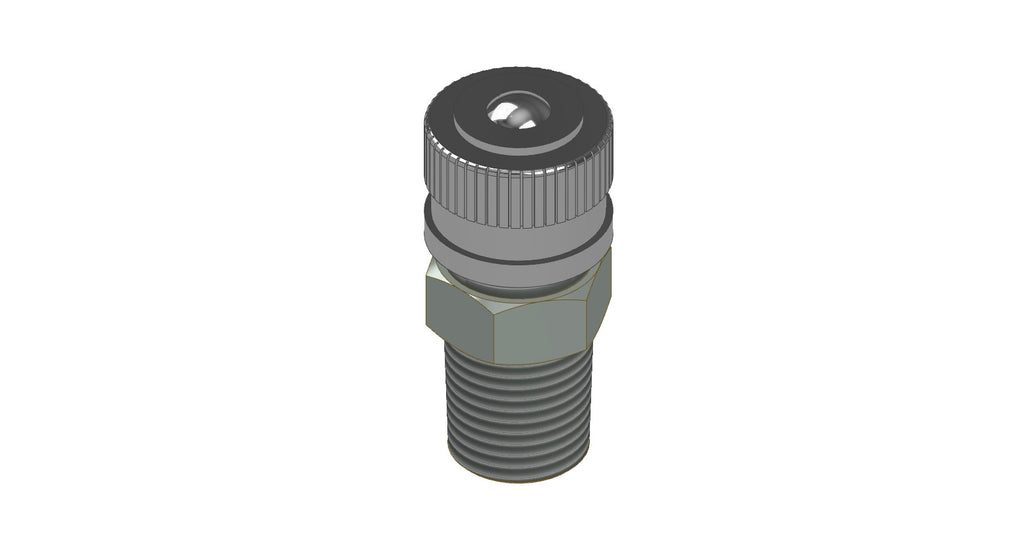
| Valve stem assembly | 14878-P (both) | |
| Collar / hose O-rings | 05240-P, 06978-P (both) | |
| Foot stand | 03109-P (both) | |
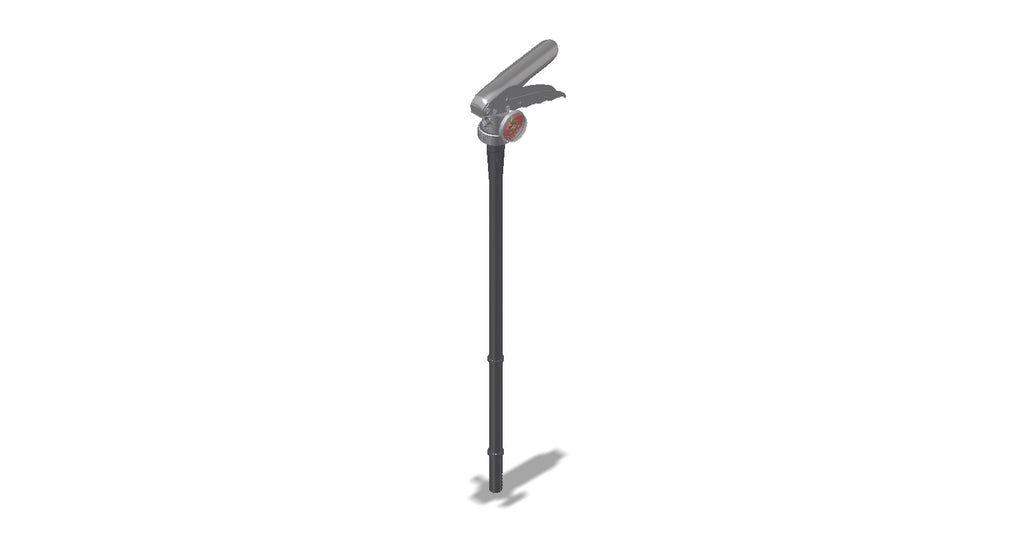
| Downtube / retainer assembly | 16266-P | 16267-P |
| Recharge charge | 530-2 | 660-2 |
Two line items differ; everything else in the valve train is one part number across both sizes. Amerex notes that "All Valve Assemblies include Valve Body, Gauge, Collar Nut, O-Ring, Lever and Handle."
The older B260 and B262 are a different story — check the label first. They take valve assembly 14249 rather than 14345, a different hose assembly, fill adapter PN 09492 where the C-series takes PN 02141, and even a different assembly torque: "For B260 and B262 models, torque swivel nut lightly with 15/16" wrench. For C260 and C262 models, torque hose end hand tight." Our recharge agent and fill adapter guide maps the adapter threads across the line.
Recharge is not a topping-up operation: "Discharge all remaining pressure and wet chemical solution... Do not top off or reuse wet chemical." The Parts Book lists Charge 530-2 as "two 6 liter bottles" and Charge 660-2 as "two 2½ gal. bottles."
Service intervals to budget for
Wet chemical sits in Amerex's five-year hydrotest group — alongside water mist, water, foam and carbon dioxide — rather than the twelve-year group its dry chemical neighbors belong to. The full quotation and the agent-by-agent split are in Amerex CO2 is different. What the wet chemical service manual adds is the cost line: "REPLACE EXTINGUISHING AGENT WITH NEW AMEREX CHARGE AT TIME OF HYDROTEST." So: monthly inspection, annual maintenance done professionally, and a hydrotest plus fresh charge every five years — against twelve for a dry chemical unit on the same wall.
What we stock
Extinguishers — the C260 6 liter and C262 2.5 gallon, both 2A:K, plus the Coast Guard C260CG and C262CG — all four in the kitchen and restaurant and wet chemical collections, with the CG pair also in marine and Coast Guard approved.
Agent — Charge 530-2 for the 6 liter models, Charge 660-2 for the 2.5 gallon, alongside the rest of the recharge agents.
Service parts — the 14345 valve assembly and 27476-P001 hose and nozzle common to all four, plus the size-specific 16266-P001 and 16267-P001 downtube and retainer assemblies. Valve stems, gauges, O-rings, pull pins, levers and footstands sit under service parts.
Brackets — the 810CG that completes Coast Guard approval, and the 810 box-type vehicle bracket.
Outfitting a kitchen, a fleet of trucks or a galley? Send us the layout and we'll come back with options and lead time — request a quote.
Sources
Ratings, capacities, discharge times, ranges, dimensions, temperature range, agent description and bracket assignments are from Amerex Corporation's Hand-Portable Fire Extinguishers catalog. Service intervals, agent warnings, mounting, Coast Guard and recharge instructions are from Amerex Owner's Manual P/N 27794 (hand portable extinguishers) and Owner's Service Manual PN 13259 (wet chemical portable extinguishers, models B260/B260CG, B262/B262CG, C260/C260CG and C262/C262CG). Part numbers and fitment are from the Amerex Portable & Wheeled Parts Book, Part No. 27277. Amerex lists these models as UL Listed and conforming to test standards CAN/ULC-S554, UL 8, CAN/ULC-S508 and UL 711. Code requirements are not ours to interpret — consult the current edition of NFPA 10 and confirm type, quantity, placement and travel distance with a qualified fire protection professional and your authority having jurisdiction. Where a rating, agent or approval is critical, confirm it against the extinguisher's own label and Amerex's current documentation.
ShopAmerex.com is owned and operated by Centurion Holdings Group LLC, an independent authorized distributor of Amerex Corporation products. We sell equipment and factory OEM service parts — we do not perform inspection, service, hydrostatic testing or recharging.