
Extinguishers rarely fail an inspection for a dramatic reason. They fail because the tamper seal is gone, the gauge needle sits outside the green, the nameplate got turned toward the wall, or somebody stacked pallets in front of the cabinet.
Nearly every one of those resolves to a part number rather than a new extinguisher. A few do not — and Amerex draws that line in its own service literature, in one word: REJECTED.
The checklist your AHJ is working from
Amerex reprints it in P/N 05602, its service manual for stored pressure hand portable dry chemical extinguishers. It first defines the exercise: "Inspection is a 'quick check' that a fire extinguisher is available and is in operating condition," done "by verifying that it is in its designated place, that it has not been actuated or tampered with, and that there is no obvious physical damage or condition to prevent its operation."
Then the list, verbatim — "[NFPA-10] Periodic inspection of fire extinguishers shall include a check of at least the following items":
- "Location in designated place."
- "No obstruction to access or visibility."
- "Pressure gauge reading or indicator in the operable range or position."
- "Fullness determined by weighing or hefting for self-expelling-type extinguishers, Cartridge-operated extinguishers, and pump tanks."
- "Operating instructions on nameplate and facing outward."
- "Safety seals and tamper indicators not broken or missing."
- "Examination for obvious physical damage, corrosion, leakage, or clogged nozzle."
Amerex's CO2 manual, P/N 05603, prints a six-item version: no gauge line, and "Determine fullness by weighing or hefting" instead. P/N 27794 agrees: "Carbon Dioxide extinguishers determine fullness by weighing or hefting" — covered in our guide to CO2 weight checks and parts platforms.
Two failures that happen before anyone touches the extinguisher
Items 1 and 2 are about the wall. P/N 05602: "NFPA-10 requires that hand portable extinguishers with a gross weight less than 40 lbs. be hung with the top of the extinguisher not more than 5 ft. (1.53 m) above the floor," and for units over 40 lbs. (18.14 kg), "not more than 3 ½ ft. (1.07m) above the floor." On access: "Never install the extinguisher in a location where a potential hazard would prevent easy access." Amerex ends its annual maintenance procedure with a bracket check — the unit goes back "making sure that it fits the bracket properly and the bracket is securely attached."
That placement language is written for the standard portable lines. Amerex publishes the opposite instruction for its High Performance line: P/N 05616 says "Do not place this extinguisher close to a potential fire hazard," and recommends "no less than a 50 foot distance from a potential hazard while leaving an unobstructed access." Check which manual covers the unit before reading an inspection finding as a placement failure — the High Performance and Z-Series units are covered in our guide to extinguishers for heavy equipment and work trucks.
Every checklist line, and the part that answers it
The middle column quotes Amerex's own maintenance and troubleshooting instructions from P/N 05602 and P/N 05603; the right column is what each resolves to in the Amerex Parts Book (P/N 27277).
| Finding at inspection | What Amerex's manual says | Part in the Parts Book |
|---|---|---|
| Tamper seal broken or missing | "Install new tamper seal if broken and record service data on the extinguisher inspection tag." (05602) | 01387-P Lock Wire Seal (Yellow), which recurs across the portable parts lists |
| Ring pin bent, missing, or hard to pull | "Check ring pin for freedom of movement. Replace if bent or if removal appears difficult." (05602) | 00160-P Ring Pin, Stainless Steel; 16268 small ring pin (1 lb. and 2½ lb.); 06901-P non-magnetic |
| Gauge bent, damaged, or wrong type | "If bent, damaged or improper gauge, depressurize and replace." (05602) | Pressure rating and parts list, not valve material alone: 03103-P – 195 PSI (aluminum valve lists); 03965-P – 195 PSI (brass valve and High-Flow lists); 05225-P – 240 PSI (6 kg–30 lb High Performance and Z-Series); 27603-P – 195 PSI (30 lb Class D) |
| Corroded lever, damaged handle, loose rivets | "If lever, handle or rivets are damaged replace with proper Amerex part(s)." (05602 and 05603) | 11825 Lever & Rivet (aluminum valve); 11826 Handle & Rivet, 5 to 10 lb.; 12405 Handle & Rivet, 20 lb.; 01060-P Rivet Only for Lever |
| Clogged nozzle, damaged hose, brittle CO2 horn | "Inspect nozzle or the hose & horn assembly for damage – replace as necessary." (05602) "Replace the horn if brittle, cracked or deformed." (05603) | Orifice-specific: 14849-P (B402, .157), 05564-P (B456, .191), 11221-P (A411, .209); CO2 01782 (330) and 01705-P (331, 332) |
| Nameplate unreadable, peeling, or turned inward | "Check to make sure that the instruction nameplate is securely attached and legible." (05602) | Model-specific nameplates — see below |
| Leak at the collar O-ring | "Remove valve assembly, remove and discard O-ring, clean collar… install new collar O-ring." (05602) | 05241-P Collar O-Ring, aluminum valve; 05240-P brass valve; 01124-P CO2, 1 1/8" |
| Leak through the valve | "Check valve stem seating area for scratches or foreign matter… Install new valve stem assembly." (05602 and 05603) | 06092-P Valve Stem Assembly, aluminum valve; 06093-P brass valve; 01539-P CO2 |
| Leak in the cylinder | "Contact Amerex if under warranty, otherwise mark 'REJECTED' and remove from service or return to owner." (05602) | None. The cylinder is finished. |
That last row is the only line in the table with no part number behind it, and it is not peculiar to dry chemical: the same corrective action appears across Amerex's hand portable service manuals, from water (P/N 05601) to Halotron I (P/N 14425) to wet chemical (P/N 13259).
The nameplate caveat almost nobody mentions
"Operating instructions on nameplate and facing outward" is a checklist line, and Amerex's 2026 portable catalog explains why it earns one: "The extinguisher nameplate contains specific information on 'HOW TO USE' the particular extinguisher. The label instructions vary slightly according to type and size."
Amerex publishes model-specific replacements — the 26964 for the Z-Series 713 and 790, the 25017 for the wheeled 495. One caveat travels with them: the Parts Book footnotes those entries to say the replacement plates do not carry the UL or USCG listing marks, so a new plate restores the operating instructions and maintenance data but not the listing — set out in full, with Amerex's exact footnote wordings, in our guide to maintenance intervals and the date of manufacture. If your inspection turns on a legible UL mark, or the unit is a marine installation, raise it with your service company first.
P/N 05602 is equally blunt about sourcing anywhere else: substitute parts "may be incorrectly labeled as UL component parts, some are advertised as Amerex type. None of these meet UL requirements and all of them void the Amerex extinguisher warranty and UL listing. DO NOT SUBSTITUTE."
Two findings worth a second look before you order
A gauge outside the green is not automatically a gauge failure. P/N 27794 notes the indicator "will vary slightly due to temperature, but should always be in the GREEN area if it is fully pressurized," and P/N 05602 splits the finding three ways: "If bent, damaged or improper gauge, depressurize and replace… If pressure is low, check for leaks… If over pressurized (overcharged), depressurize the extinguisher and follow recharge instructions." Only the first is a gauge purchase, and it has to match pressure rating and valve material — our Amerex gauge cross-reference sets out which belongs where.
A clogged nozzle is the other. Amerex hose and horn assemblies are listed by orifice size: the Parts Book puts .157 against the B402, .191 against the B456 and .209 against the A411, as our guide to hose, horn and nozzle orifice fitment lays out. CO2 adds a check of its own: P/N 05603 calls for a hose continuity test, because "Carbon dioxide hose assemblies have a continuous metal braid that connects to both couplings to minimize static shock."
The collar tag that proves the six-year was done
One finding has nothing to do with the hardware: the six-year maintenance. P/N 05616 states the rule, and why the tag is hard to fake: "NFPA 10 requires that a 'verification of service' external collar tag be installed on the extinguisher whenever a Six Year Maintenance is performed. The 'verification of service' tag can only be installed if the operating valve has been removed."
The tag sits under the valve, so it is evidence of a teardown rather than a sticker applied at the truck. What the six-year covers, which agents it applies to, what resets its clock, and the states Amerex notes require complete maintenance annually are all in our guide to Amerex maintenance intervals and the date of manufacture.
When a cylinder is finished — and when it only looks that way
Amerex's portable literature draws one absolute line. Two other findings get mistaken for it.
A leak in the cylinder ends it. The troubleshooting tables in P/N 05602 and P/N 05603 give the same corrective action: contact Amerex if the unit is under warranty, otherwise mark it rejected and remove it from service or return it to the owner. P/N 05602 prints the word in capitals — "REJECTED" — and no part number follows it, because the failure is in the pressure vessel itself.
Cylinder damage sends the unit to a test, not to a part. P/N 05602: "Inspect the cylinder for corrosion, abrasion, dents or weld damage. If any of these conditions are found and you doubt the integrity of the cylinder, hydrostatically test to factory test pressure marked on the nameplate (label), using the proof pressure method, in accordance with CGA C-1 and NFPA 10." Corrosion is not by itself a verdict in the manual — it is the trigger for a proof-pressure test, done by a qualified service company. The Parts Book publishes no part that repairs a cylinder, so the test, not a purchase order, settles it.
The calendar is usually a date, not a defect. P/N 27794 sets hydrostatic testing at five years for the water mist, water, wet chemical, foam and carbon dioxide families and twelve for dry chemical, dry powder, Halotron I and Halon 1211 — Amerex's sentence is quoted in full, with the CO2 particulars, in our CO2 guide. Those are tests, not endings. Halotron BrX is the exception — the same manual states those units "are not rechargeable and shall be removed from service 12 years from date of manufacture on the UL nameplate," and the 2026 catalog says it in one line: "HALOTRON® BrX EXTINGUISHERS HAVE A 12-YEAR SERVICE LIFE AND ARE NON-RECHARGEABLE." No part fixes a date; near a threshold, run the numbers with our guide on recharge or replace economics.
One boundary applies throughout. Ordering the part is a facility job; fitting most of them is not. P/N 05602 publishes its maintenance and recharge instructions as a guide for qualified service personnel, and states that "Amerex strongly recommends that the maintenance of portable fire extinguishers be done by a trained professional." Depressurizing, replacing a gauge, pulling a valve, changing an O-ring or stem, and recharging all belong to a qualified service company. We sell the OEM parts they install.
What we stock
Seals and pins — the 01387-P006 yellow tamper seal and 00160-P024 stainless pull pin, with chains and non-magnetic pins across O-rings, seals and pull pins.
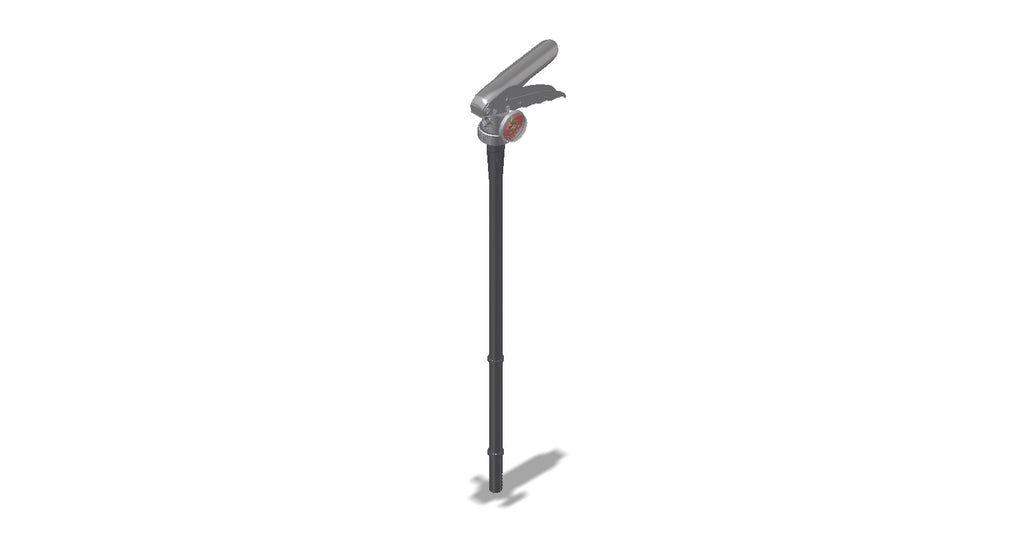
Valve internals — the 03103-P006 195 PSI gauge, 06092-P006 valve stem assembly and 05241-P024 collar O-ring, from valves, gauges and downtubes.
Levers and rivets — the 11825 lever and rivet set and 01060-P024 rivet, in handles, levers and carriers.
Hoses and horns — the 14849-P001 .157, 05564-P001 .191 and 11221-P001 .209 assemblies and the CO2 01782 hose and horn, within hoses, nozzles and horns. Model plates sit in nameplates, labels and decals — all inside 495 line items of service parts.
Send the model numbers off your nameplates and we'll come back with parts, quantities and lead time — request a quote.
Sources
Every quotation above comes from Amerex Corporation's own literature: Owner's Service Manual P/N 05602 (stored pressure, hand portable dry chemical), P/N 05603 (hand portable carbon dioxide), P/N 05616 (high performance dry chemical portables), and the Owner's Manual Hand Portable, P/N 27794, the source for the gauge-in-the-green wording, the hydrostatic intervals and the Halotron BrX service life. The nameplate and Halotron BrX statements are also drawn from Amerex's 2026 Portable Fire Extinguisher Catalog. The identical "Rejected" verdict appears in P/N 05601 (stainless steel water), P/N 14425 (Halotron I) and P/N 13259 (wet chemical). Part numbers and the nameplate footnotes come from the Amerex Portable and Wheeled Parts Book (P/N 27277). NFPA 10 and CGA C-1 are characterized only as Amerex characterizes them — consult the current editions and your AHJ, and confirm any critical finding against the extinguisher's own nameplate and with a qualified fire protection professional.
ShopAmerex.com is owned and operated by Centurion Holdings Group LLC, an independent authorized distributor of Amerex Corporation products. We sell equipment and factory OEM service parts — we do not perform inspection, service, hydrostatic testing or recharging.